

THE BRAIDED RIVER
Source
High in the Southern Alps of New Zealand, the Waimakariri River is born from glacial melt and alpine drifts. It descends in rivulets, tumbling over scree and fractured granite into valleys carved by countless seasons. Down, well beyond the valleys, the Canterbury floodplain is a shifting canvas of stone and water—the river now weaving silver filaments across wide, gravelly flats in a network of channels that shift with every cycle of flood and drought. Along its banks, willows lean in, their roots clutching at silt. This is the quintessential South Island river, braided, restless and patient. It finally reaches the open sea just north of Christchurch.
Simon Allison was raised in this southern lifecycle, with an early Christchurch life spent crossing and exploring the rivers and foothills of Nelson and Canterbury. At river crossings he was always seen to pause—or rather stop—and marvel at the meltwater, the black-green pools, the fervent current rushing, the boulders spawned and dumped, and the bifurcations of splintered watery paths.
It is these landscape marks that artists carry from their early days, embedded in memory, to be uplifted in moments of crisis or freewheeling ecstasy. They are the sustenance of a lived and restless practice. For this artist, the silvery braids forcing their way through the unyielding have been his raw materials conceptually and emotionally.
Foundry
Now at Lockbund, in his hand-built Oxfordshire foundry, not far from the carved watery trench of the Oxford Canal, the air hangs with heat born of fire and intent. This foundry has succeeded for more than four decades through Simon Allison’s deep knowledge of bronze casting. Here, stray visitors are welcomed to observe the ‘pour’, to witness that moment when the alchemist himself turns liquid bronze into art. In true physical labour, shielded from the intense heat, the Lockbund artisans gather around the crucible where bronze is coaxed from solid to shimmering liquid. Two lift the ladle of molten metal that glows like the heart of the earth and pour it down sprues into waiting molds. This is the river of fire carrying the vision of the artist.
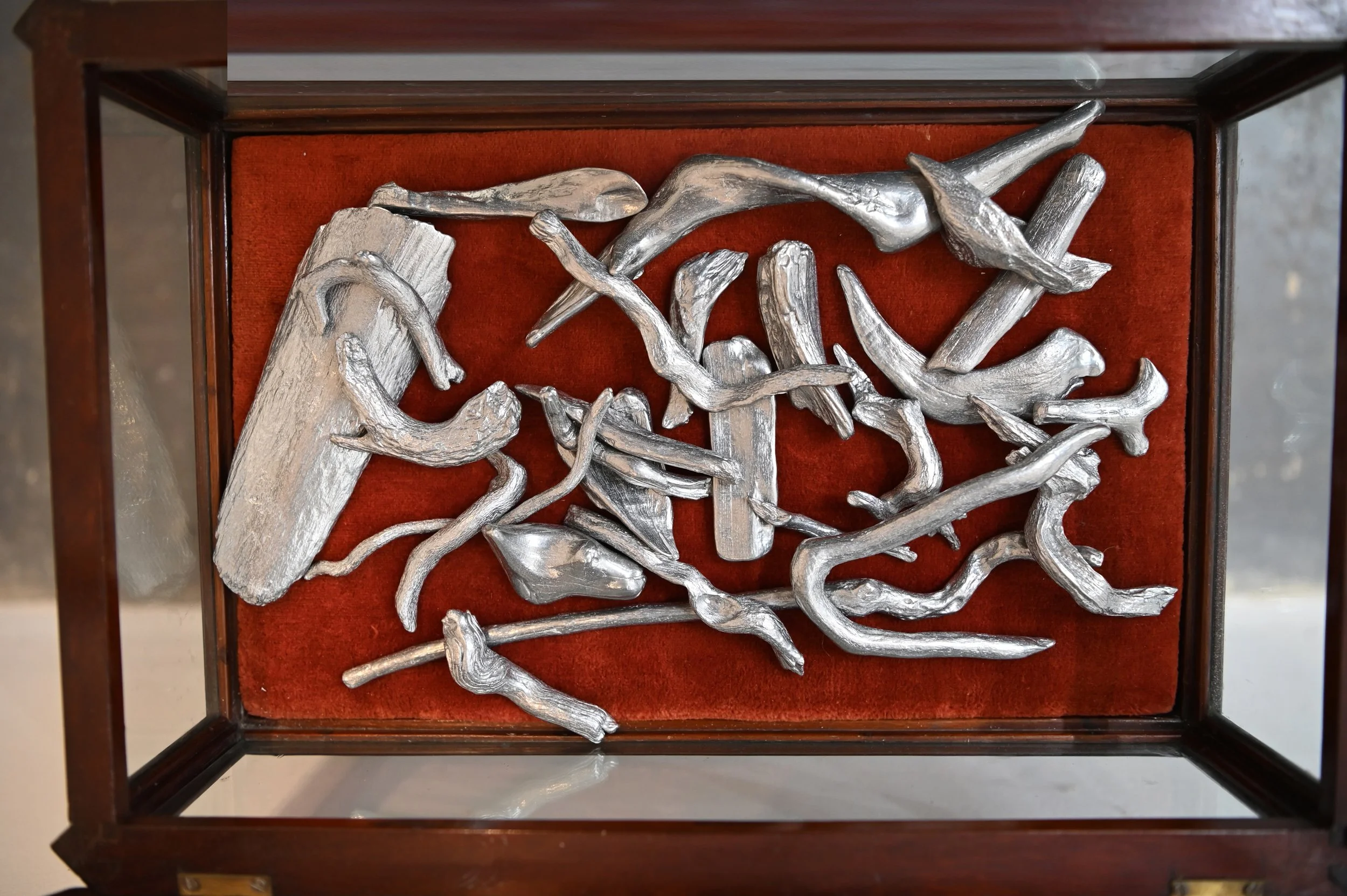
As the bronze cools, the cast captures the moment fluidity becomes form waiting to emerge when the covers are finally broken away. In the finishing rooms, the Lockbund artisans refine each piece, chasing lines, burnishing surfaces, and coaxing patinas that shimmer like river stones beneath the water. Simon Allison is an authority on all the casting stages. After all, he has perfected them over half a century since art school training and theatre design. The result is sculpture with an inner vitality—a testament not only to the hands that shaped it, but to the enduring dialogue between material and imagination. This then is the knowledge that he brings to creating objects that hold a place in the contemporary art world: making molds; creating wax pattern; optimising the gating systems; applying ceramic shells; firing furnaces; pouring molten metal and formulating the chemistry of patinas.
Materiality
The foundry naturally positions Simon Allison as a sculptor with an unsurpassed material knowledge. His objects command a presence in any environment that curates them. The Far Far Gallery provides a lofty space that channels light and air with neutral walls and Spartan floors. Outside, standing on plinths, the pink Synapse, 2015, and blue Data Transfer, 2015, assert themselves as an architecture of science, yet present heightened colours of the stage—face painted and waiting for the glow of limelight or the blaze of spotlight as dusk falls.
Simon Allison’s material knowledge extends to the behaviour of timber. On a monumental scale, two turned timber Earth Gods, 2017, stand in weathered silence beyond the gallery walls. Inside, for the installation Spin Cycle, 2017, again using lathe and chisel he has turned more giant sections of oak, then uprighted them to stand as tall as Roman temple columns. A scattered Debris Field, 2017, of bronze-cast sheets of corrugated iron lies casually at their feet. Like the Earth Gods outside the gallery, these trees were felled by nature’s storms and now stand like watchers at Gallipoli, or as mysterious totems of past endeavours. Some have been re-awakened through new materials of fibreglass or bronze. One looked back into History and turned to white Carrara marble.
Not only the materials of the casting process, but the processes themselves, have laid the foundations of Simon Allison’s oeuvre. In many works, the artist seeks surfaces that his gouging tools can infiltrate. In plys of timber or folds of corrugated card, he cuts and hacks open trenched trajectories in their surface to create open molds for liquid lead from crucibles in his studio. He then pours the lead into the wounded surface to create crossings, braids, striations and even texts of unnerving permanency. How striking it is, that the movement of a human hand and the guidance of the will can be rendered so permanent. The waters of the braided river are now filaments of lead.
In earlier works of some two decades ago, the artist cut trenches into stones of modest size, filled them with molten lead, and after all had cooled, he chased the seams, ground and polished the surface to lustre with river stone grace. The viewer is held in that forever moment of reaching down into the fast-flowing river, dislodging a stone and marvelling at the beauty of its polished surface—radiating smooth and best when shining wet. The lead inclusions appear to be so effortlessly inserted by the geology of deep time.
Many of the works which followed were also forged in fire. Travels with the artist turned into focused searches for found materials whose surfaces he could infuse with lead. Of course, those surfaces carried with them the cultural strands of a prior life, now waiting to be transformed. Found materials were sometimes harvested at the hardware store, where sheets of marine ply are laid out to flirt as willing receptors. From under stacks of ply, the artist even acquired pallets that had once held them. Their utility held his attention as he transformed them into both wall works and free-standing sculptures that could bear the weight of the poured lead. In Ziggurat Red, 2017, the structural support that a pallet normally offers is placed on edge in a sliced free-standing lean. The created tension expands to the viewer, while the original sprayed colours bleed from nail holes bared during the pallet’s deconstruction. All this transformation is part of an endless cycle:
“Old stone to new building, old timber to new fires
Old fires to ashes, and ashes to the earth”
Cultural braids
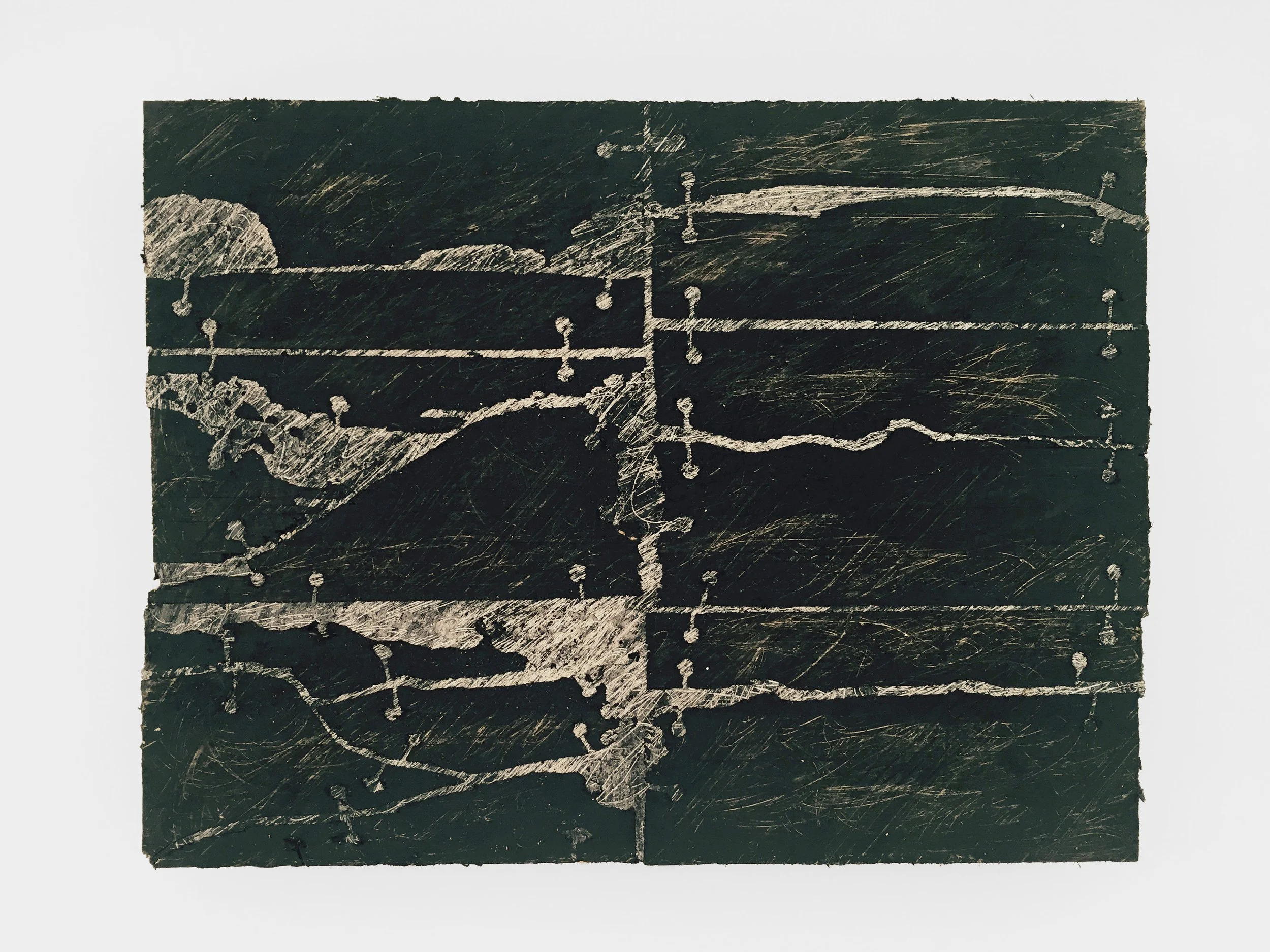
In an early work Six Days, 2007,the artist references the outlines of Colin McCahon’s Six Days in Nelson and Canterbury, 1950, held in the Auckland Art Gallery, Toi o Tamaki. McCahon is New Zealand’s seminal artist imbuing a spiritual significance to textual marks. In re-drawing the McCahon with poured molten lead in blackened plywood, Simon Allison references Roman architecture that used metal locks of hidden iron to anchor temple arches into stone slabs. (Such locks pre-figured modern-day zips that effectively lock two sides of a garment together.) In Six Days, the six timber fragments are locked together by a lead zip—mostly hidden—but the zip appears on the surface of the work as a running line of paired lead dots.
The clean repeated fifty panels of Black and Umber Grid, 2022, shoulder curved lead gestures in their surface, each locked in place in a way of linking time and place, or different periods of art history. The overall effect is liminal and almost Zen-like. By comparison, the effect is similar to the dragged paint flourish of multi-sectioned works by noted Irish born American Sean Scully. The Scully sections notoriously push and pull, while here the viewer is forced to take in the black and umber panels simultaneously in the visual field and calmly balance one against the other.
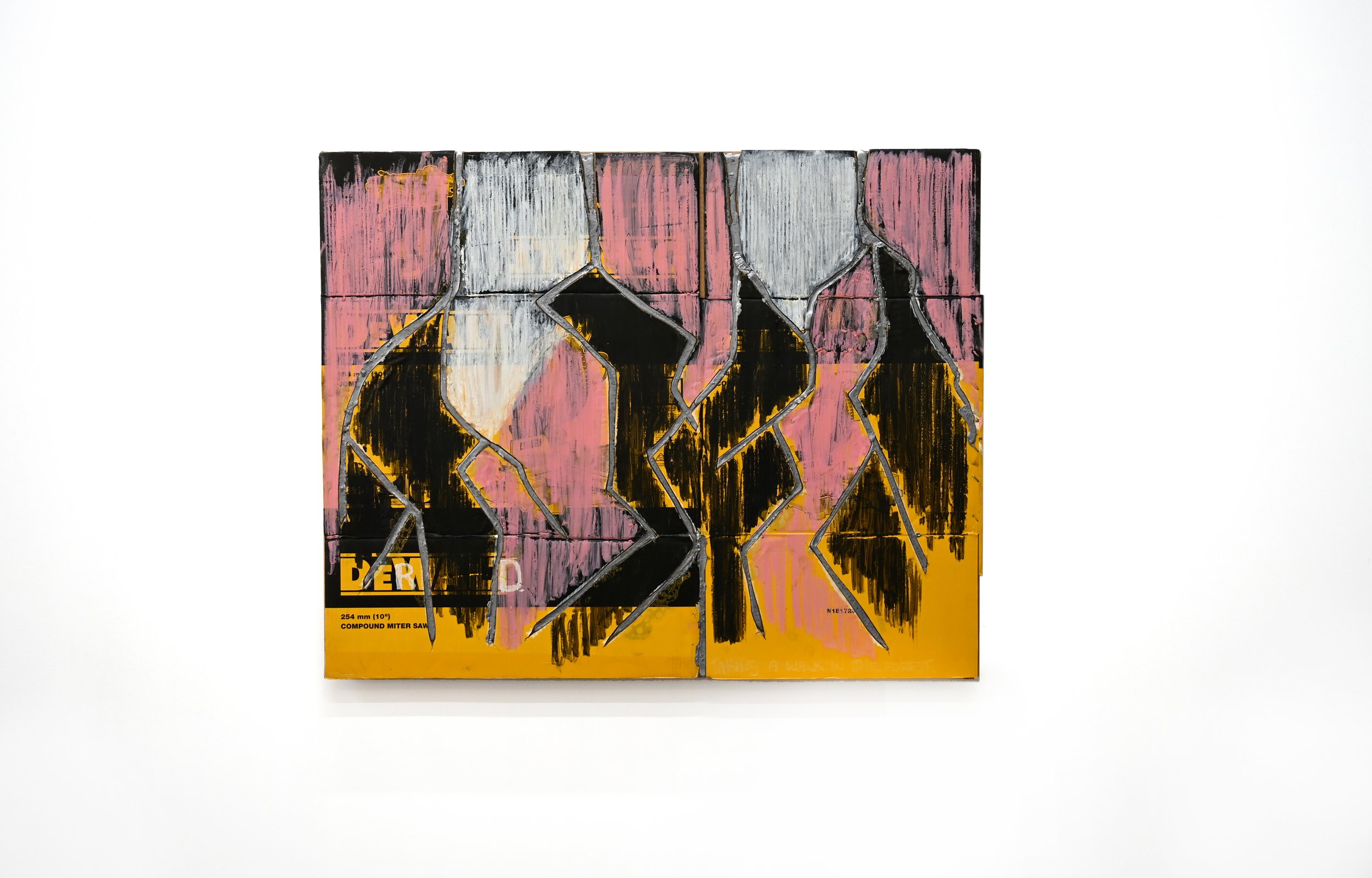
Seeking links that lock time and place together, Simon Allison leaves the hardware store and heads for the open road to scour the countryside for discarded fencepost sections, road signs, corrugated cardboard and pieces of shoreline debris. These things carry the long worry of time into the present moment. With a bold coating of yellow road-marker colour, the finished work of Jewel X, 2018, swings into the contemporary with a dramatic change in scale. How sweet it is for a small work to hold court on a large white gallery wall and fend off the murmur from an opposite wall. This is the stuff of theatre—the artist cut his teeth in set design—where visuals are floodlit for audience reach. Strong colour carries. It intoxicates with a social conscience and asphyxiates any background noise.
Human contact
When the artist turned his attention to recycling stations and used furniture stores, he returned with brackets of wooden kitchen chairs for immediate disassembly. By removing the legs and backs the seat sections are perfect for wall display. These remainders carry the weight of human contact, a connection to a cultural skin that resonates with age. Old is better, so that cracks in the waxy timbers—that hold the sweat of those that have been—are perfect to house the zips of poured lead. When molten lead is fired into deep trenches on the underside of a seat, it leaves organic rivulets on the surface of the seat itself in random spillage that glorifies the human gesture. The artist makes the empowered choice to leave these gestures as they are.
Many used furniture stores yielded up their stocks of wooden breadboards to a new life. The artist relished their attachment to the culture of their age—some imported, some handmade, but all revitalised into pivotal groups from the Signal series that began in 2023. Many are intensely coloured, but some are simply sectioned in black and cling to our senses like ancient African masks. The burnished lead inserts shine jewel-like against curves that coyly hide behind the painted clobber. Such turns in Africa. In fact, our thoughts are carried to a myriad of social references. In return, these works thrive on nuance and cultural linkage.
Words
From early appointed moments at art school, the artist has lived for gesture, for the theatrics of performance art, and for the recorded movement of the hand across the page Trace and gesture are so vibrantly human. (O ye programmers of AI—take notice.) This humanness can be seen in the appearance of deformed lettering of the texts in the Headstone Series. The wordings appear deliberate and hard won. No stencil. Just hard won. And, with the appearance of the Meander works, gesture and chance make their mark. This essence is caught small, with gesture encapsulated in elaborate framing which acts as a doorway to a welcoming and immeasurable space.
The artist has been a keen observer of gravestones ever since he was a child living in Nelson directly opposite the colonial graveyard of Fairfield. This is not to call on the macabre but rather to focus on the headstones that remain, many standing well beyond a century, their inscriptions crazed with lichen. This is where History tends to hide.
“The houses are all gone under the sea
The dancers are all gone under the hill”
The lead inserted letters exhibit a greenish patina over time in their granite and marble surrounds. When words and religious phrases are appropriated from such a source, the texts take on new associations as the linkages between the signifier (word) and the signified (meaning) are broken. In the recent Headstone Series 3, 2025, the words SORROW and VANQUISHED are lead-poured into a wooden timber surface. The words, carefully extracted from their headstone context, are now separated and flow into new meanings as the eye reads one, then the other. Under foundry protocol, the surface has been burnt and blackened. In moving beyond the world of peaceful remembrance the image now builds on searing ironies. There is a source of unrelenting fire buried deep in the braided river.
Peter James Smith, August 2025
1. T.S. Eliot, Four Quartets, East Coker, I, lines 5,6
2. Op cit., II, lines 49,50